

Mood tracking is one of those bullet journal habits that sounds a bit abstract until you actually try it — and then you wonder how you ever journaled without it. A mood tracker is simply a visual record of how you felt each day. Over weeks and months, it becomes a surprisingly honest portrait of your emotional patterns.
The challenge is that traditional mood trackers require you to draw out grids, colour-code emotions, or hand-letter labels — which is beautiful when you have time, and completely skipped when you don't. Emotion stickers solve this. Here's how to set one up.
What Is a Mood Tracker and Why Does It Matter?

Image Source: Canva
A mood tracker is a section of your planner or journal where you record your dominant emotion or energy level each day. It doesn't need to be complex — the goal is simply to create a visual record you can glance back at.
Over time, a mood tracker can reveal things like:
-
Which days of the week are consistently harder for you
-
Whether certain activities (exercise, cooking at home, early mornings) correlate with better moods
-
Patterns in your energy levels across the month
-
How your mood shifts during stressful periods versus calm ones
This kind of self-knowledge is genuinely useful — and it's surprisingly hard to build without a consistent tracking system.
Option 1: The Daily Sticker Method (Easiest)

Image Source: Pinterest
The simplest mood tracker requires no setup at all. At the end of each day, flip to that day's page in your planner and place one emotion sticker that best represents how the day felt.
That's it. No grid, no legend, no colour coding. After a week, you have a visual strip of emotions across your daily pages. After a month, scroll back through and the pattern is immediately obvious.
Pro tip: Place the sticker at the END of the day, not the morning. You're recording how things actually went, not how you hoped they'd go.
Option 2: The Weekly Mood Strip
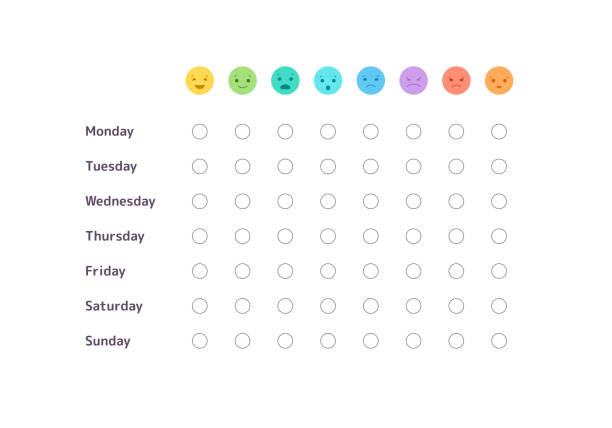
If you use a weekly planner layout, dedicate one row at the bottom of your weekly spread to a mood strip. Draw (or use a tracker sticker to pre-format) seven small boxes — one for each day. At the end of each day, place your emotion sticker in that day's box.
At a glance, your entire week's emotional journey is visible on one page. It takes about ten seconds per day to maintain, and the visual payoff is immediate.
Option 3: The Monthly Mood Grid

For a more detailed view, set up a monthly mood grid on a dedicated page at the start of each month. Create a grid with the dates of the month along one axis — then each day, place one sticker in that date's cell.
At the end of the month, you have a complete emotional map of those 30 days. This is particularly useful during difficult periods — it's grounding to see that even a hard month had genuinely good days scattered through it.
Choosing the Right Emotion Stickers
The key to a useful mood tracker is having enough sticker variety to actually capture the nuance of your days. A set that only covers 'happy' and 'sad' won't cut it — most days are more complicated than that.

Our Emotion Sticker Sheets feature illustrated characters for a full range of feelings — motivated, tired, anxious, content, sick, laughing, teary, and more. The Mixed Mood & Activity Sheet (Sheet 5) is particularly useful for mood tracking because it combines emotion characters with activity icons, letting you record both how you felt and what shaped that feeling.
Making It a Habit
The biggest challenge with any tracker isn't setting it up — it's remembering to update it. A few things that help:
-
Keep your sticker sheets inside your planner's pocket or cover so they're always within reach
-
Link it to an existing habit — update your mood tracker when you close your planner at the end of the day
-
Don't be precious about missing a day. If you skip Tuesday, just leave it blank and carry on from Wednesday. A partial record is still useful.
Browse our full Emotion & Mood Sticker collection at curvynoodle.com — and start building a record of your days that actually means something.
0 comments